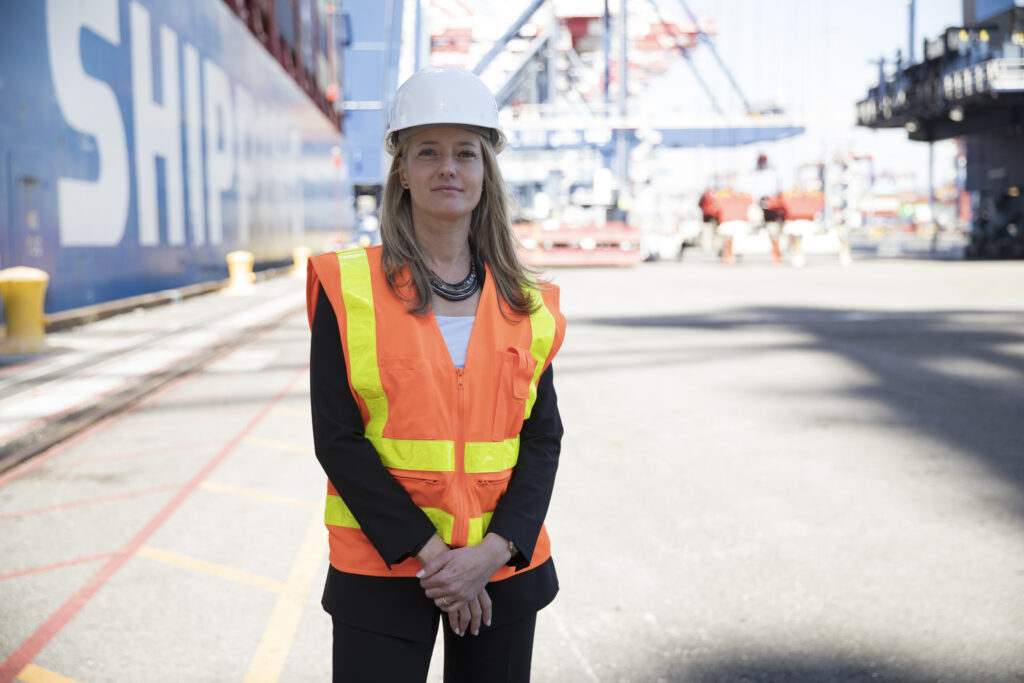
As part of its “Women in Maritime” coverage, Rebecca Moore of Riviera interviewed ZEMBA President and CEO Ingrid Irigoyen.
What inspired you to pursue a career in the marine industry?
My initial interest in oceans and sustainability began when I was a teenager living on the eastern coast of Florida. This was a challenging time in my life, and I found being in and near the ocean deeply healing and inspiring. Over the course of that time I also observed the rapid degradation of the coastal ecosystems I loved – my favourite beaches rapidly eroding and trashed with marine debris, a lack of public access to the ocean that belongs to all of us, declining marine life, and even at a young age understood this was more than just an environmental issue – it also threatened the well-being of local people and the economies they depend on. I would ask myself questions like “Why do we seem to be the only species routinely soiling our own nest? And why do we seem to deeply misunderstand and undervalue our very planetary life support system – isn’t this essential for us humans to thrive in the long run?” This sparked an early passion and so, naturally, I went on to study environmental science and management with a focus on oceans and coasts.
Through my early career I engaged with a broad range of ocean-dependent industries, government agencies, local communities, advocacy groups, and other stakeholders, and quickly developed an appreciation for the complexity of ocean management challenges. I could see that, generally speaking, most points of view and concerns were valid and only thoughtful engagement and creative problem solving could lead to sound outcomes that achieve multiple societal objectives. Working as a facilitator at the intersections of economics, science, and policy showed me there is usually not an easy or obvious solution to most conflicts, and frankly I got a thrill in tackling the challenge.
After spending many years working both domestically and internationally with fisheries and seafood, ocean energy, coastal land use, marine planning, climate mitigation and resilience, and other topics – all of which intersected directly with maritime transport systems, I determined that the skills and knowledge I had accumulated could be applicable to the maritime sector and its decarbonisation challenge as well. A multistakeholder, science-based, and thoughtful approach is essential to ensure the next-generation maritime sector allows trade to flow and goods to remain affordable while also advancing critical long-term climate and ocean sustainability objectives, among many other goals.
What are your responsibilities in your current role?
As the founding leader of ZEMBA, I work alongside my excellent team of colleagues and partners to bring together experts and stakeholders across disciplines to design – and now demonstrate – that we can build a business case for producing and deploying new advanced maritime fuels and technologies that meet the long-term economic and sustainability needs of humanity, which of course relies heavily on ocean transport. We do this through organising collective freight buyer procurement of maritime emissions reduction generated with the cleanest and most scaleable fuels and technologies ready for commercial deployment. By facilitating larger and longer-term advanced market commitments from the maritime sector’s customers, we hope to pull these new solutions forward in time and kickstart the clean energy transition in shipping.
One of my core responsibilities is to be a careful listener and strategist. It is my responsibility to stitch together approaches that will work in the real world to help accelerate a transition that will be good for the triple bottom line, and drive impact quickly. I’m constantly trying to strike the right balance between thoroughness and speed, as well as practical realities and high ambition, while keeping a large group of actors across the value chain, with sometimes diverging interests, moving in sync.
I lead a team of inhouse and external technical experts and manage relationships with freight buyers, carriers, fuel producers, policy makers and other stakeholders. Carriers and fuel producers want to have a profitable business relationship with their sustainability-minded customers and cargo owners want to see these clean energy fuels and technologies be deployed while managing cost – my job is to ensure we are satisfying both sides of the equation. Only then will deals get done. In the maritime policy space, ensuring our key learnings through ZEMBA are conveyed appropriately to policy makers to inform their important decisions is a key aspect of the work as well.
Was there anyone who inspired or encouraged you in your career?
I’ve been fortunate to have many inspiring mentors in my life. I had professors and several bosses early in my career who were open minded and appreciated (or at least were patient with) my rebellious streak. I wasn’t a classically ’great student’ in the academic sense. I was following my passion and a desire to do deeply challenging and creative interdisciplinary work, and so was driven much more by curiosity than always getting top marks. They also helped me see that shaking things up can be essential, but it also comes with risks that must be seen clearly and managed. With boldness comes additional responsibility. Early in my career I also had mentors who worked in interdisciplinary, problem-solving spaces and coached me in managing complexity and working thoughtfully while still being highly efficient to create real concrete positive impact.
And today, I am so often inspired by our company partners who stay the course on sustainability in spite of a constant stream of incoming challenges, and by the young people around me who re-energise my passion for the mission whenever weariness sets in and who teach me new things all the time.
What have been some of your biggest hurdles along the way?
The maritime sector is an ancient industry made up of people, mostly men, who have spent most of their careers doing business a certain way. Therefore, one of my biggest hurdles in getting started was coming in as a woman with limited maritime experience and a bold new approach, and getting leaders of the sector to take our ideas seriously and view what we were offering as a business opportunity. The initial reaction from several quarters was sceptical – which I could, to be honest, completely understand at the time and therefore chose to not let it get me down. I now lead a very effective team that is mainly composed of young women, and we’ve demonstrated we can thrive in this space with a little extra effort, grit in the face of headwinds, boldness that is just the right mix of self-assurance and humility, and a very big dose of humour.
Moreover, I understand while fresh ideas are a good and necessary thing in a changing world, they must nonetheless be grounded in the reality of how the industry works and the very real constraints faced by companies that participate as buyers and suppliers in our procurements. We’re asking companies across the value chain to choose to put in extra effort and work in new ways for a potentially big collective impact. We must listen carefully to their hopes and concerns, seek and adjust to feedback when it is fair, be flexible when new information comes in while maintaining rigour and high ambition wherever possible, and hold on fiercely to what some people have called ’stubborn optimism.’
Finally, as I reflect back, my learning curve and that of most of my teammates was very steep as we designed and started execution of the ZEMBA. Of course we are still learning every day, and I believe much of our success is owed to strong trust relationships and a deeply collaborative spirit and hard work of many partners across many disciplines and viewpoints.
This interview has prompted me to look back at what I wanted from my career during those early years, and now, over 20 years later, I can say that I’m living the dream every day. What a delightful realisation.
What do you see as the biggest challenges for your company and the maritime industry?
The biggest challenge for ZEMBA and the maritime industry writ large – both for reaching its clean energy goals and generally to keep business and trade flowing – is the threat of a global economic slowdown and geopolitical disruption. Businesses need predictability, particularly if we expect them to make bold investments in a better future. Having a clear business case obviously helps tremendously, but one’s ability to seize even a strong business opportunity can be deeply undermined by chaos.
What would you say to any other young person who was thinking of a career in the maritime or offshore industries?
The maritime industry is an exciting and fast-evolving space. No matter what someone’s discipline or passion may be, there is room for them in the maritime sector. From engineers to economists to policy works to inventors to people who love working in the outdoors, there are so many ways to engage. What’s more, it is truly an essential sector for the global economy, so a space where people can establish long-term careers. And because it’s such a global industry, maritime offers the opportunity to work with people across many different cultures and to see the world.
Biography
Ingrid Irigoyen is the senior director, ocean and climate, for the Aspen Institute Energy and Environment Program (EEP), where she leads EEP’s work at the ocean-climate nexus and serves as a strategic advisor and facilitator for multi-stakeholder initiatives seeking to address climate, ocean and coastal challenges. She also serves as the president and chief executive of the Zero Emission Maritime Buyers Alliance, a non-profit organisation and first-of-its-kind buyers group within the maritime sector with the mission to accelerate the commercial deployment of clean energy-powered shipping, enable economies of scale for new solutions, and support cargo owner engagement in maritime clean energy policy. Prior to joining Aspen in 2018, she was a senior mediator and programme manager at Meridian Institute, where she devoted 13 years to the design and execution of collaborative multi-stakeholder sustainability solutions, with a special focus on oceans and coasts. Prior to this, among other positions, Ms Irigoyen was a John A Knauss Marine Policy Fellow with the US National Oceanic and Atmospheric Administration. She holds a Masters of environmental management from the Nicholas School of the Environment at Duke University and a Bachelor of Science in environmental science from the University of New Hampshire.