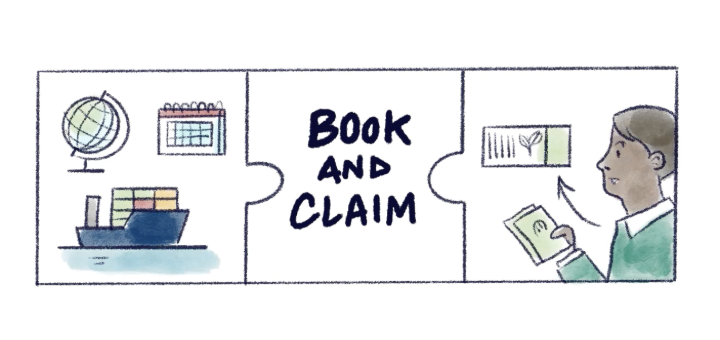
A key piece of ZEMBA’s tender process is an innovative mechanism known as book and claim. But what is this, and why is a book and claim system critical for scaling clean energy solutions?
The Challenge
Sustainable maritime fuels are in the early stages of market adoption. Commercial deployment is expanding, but the current supply of these fuels is limited and only available in specific geographies.
Many companies, including ZEMBA’s first‑mover members, are interested in using more sustainable shipping options to move goods along their supply chain. However, the current state of the sustainable shipping market makes procuring sustainable alternatives challenging. Companies cannot quickly or easily adjust their supply chains to fit the current geographic availability of low-carbon fuels. However, many companies want to access these new fuels to lower their supply chain emissions and help send strong demand signals that accelerate the clean energy transition.
This is where book and claim comes in. This innovative mechanism acts as a matchmaker between limited early supply and pioneering corporate demand. It allows first-mover companies to support and unlock sustainable shipping solutions, and claim emissions reductions to help achieve their climate goals, even if these solutions are not yet available on their specific trade routes.
The Solution: How Book and Claim Works
Book and claim systems are common tools to funnel investment into hard-to-abate sectors like aviation and maritime. These systems accomplish this by “decoupling” the environmental attributes of sustainable fuel from the physical fuel itself. These systems work when they are backed by rigorous, third-party verified, transparent systems. Credibility is essential.
Let’s explore this through the ZEMBA example.
Through ZEMBA’s tenders, members are purchasing the emissions reduction associated with sustainable maritime transport. The premium that members pay is supporting the commercial deployment of sustainable fuels somewhere in the world where the winning carrier(s) operate, just maybe not on the vessels carrying members’ specific goods. ZEMBA’s close partnership with its members, winning carrier(s) and the Katalist nonprofit maritime book and claim system, hosted by the Mærsk Mc-Kinney Møller Center for Zero Carbon Shipping and RMI, ensures the operational rigor and credibility of this approach.
A Win-Win for the Maritime Sector
As clean fuels are further scaled and commercialized, their availability will continue to expand. One day, ZEMBA members will be able to access sustainable maritime shipping services without the use of a book and claim system. However, during the early stages of the maritime sector’s clean energy transition, book and claim systems are a win-win.
Carriers and fuel producers can optimize their supply chains, access a greater pool of potential customers, and maximize efficiency. ZEMBA members and other downstream customers can support some of the first commercial deployments of sustainable fuels and claim high-integrity, verifiable, independently certified emissions reductions toward their Scope 3 targets, all without altering their supply chains.
Want to learn more? Check out the video below to learn more about ZEMBA’s pioneering utilization of book and claim in the maritime sector.
Want to Learn Even More About Book and Claim?
Here are some additional resources from our partners working to decarbonize in other hard-to-abate sectors: